
Most operations know their pick rate. Far fewer know their mispick rate, and fewer still have priced it. Industry surveys put the average picking error rate between 1% and 3%, with 35% of facilities running continual mispick rates of 1% or more. Another 19% of facilities don't measure mispicks at all, which means the real industry numbers are probably worse than the reported ones.
That gap matters because a mispick is one of the most expensive routine events in a warehouse. The wrong item leaving the building triggers a chain of costs that runs far past the price of the pick itself, and at typical error rates the annual total reaches hundreds of thousands of dollars for a single facility.
The Anatomy of a Mispick's Cost
Published estimates for the cost of a single mispick cluster between $30 and $75, with some facilities reporting $100 or more per incident depending on the merchandise. Estimates across the industry run as high as $50 to $300 per error. The range is wide because the cost stacks in layers:
- The item itself. If the wrong product ships and the right one ships after it, you may eat the cost of one or both.
- Double shipping. Outbound freight on the replacement, and often return freight on the original.
- Reverse logistics labor. Someone receives the return, inspects it, and restocks it. That's paid handling that produces no revenue.
- The re-pick. The correct item still has to be picked, packed, and shipped, so the order's labor cost roughly doubles.
- Inventory distortion. Until the error is found, system inventory is wrong in two SKUs, which can trigger phantom stockouts and bad replenishment decisions.
- Customer goodwill. The hardest layer to price and the most expensive one. B2B customers put suppliers on scorecards; consumers leave reviews and don't come back.
The Annual Math
Per-incident costs look survivable until they're multiplied by volume. One published model puts the typical annual cost of picking errors near $390,000 per business, and estimates for larger single warehouses run $400,000 to $600,000 per year.
The sensitivity to accuracy rate is steeper than most teams expect. On 500,000 annual orders, the difference between 97% and 99.5% pick accuracy isn't 2.5 points on a report. It's 15,000 mispacked orders versus 2,500: 12,500 additional returns, re-ships, complaints, and at-risk customer relationships every year.
A quick way to price your own exposure:
- Take your annual order lines shipped.
- Multiply by your measured mispick rate. If you don't measure one, industry averages suggest starting the estimate at 1%.
- Multiply by a per-incident cost. $30 is a conservative floor; use your own freight and handling numbers to sharpen it.
A mid-size operation shipping 2 million lines a year at a 1% error rate and $30 per incident is spending $600,000 annually on mispicks. That's the budget line that never appears in the budget.
Why Manual Picking Produces Errors
Mispicks aren't a discipline problem. They're a process problem. In a conventional operation, a picker walks to a location, reads a label, judges which of several similar items matches the order line, counts a quantity, and moves on, hundreds of times per shift. Every one of those steps is a human judgment made at speed, often among look-alike SKUs on the same shelf. Fatigue compounds it: error rates climb through a shift as pickers tire.
The standard countermeasures (barcode scanning, pick-to-light, voice picking) each remove some judgment calls, and they help. But they all still depend on a person navigating a storage environment full of adjacent, similar inventory.
How Goods-to-Person Automation Attacks the Error Rate
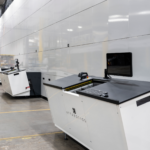
Goods-to-person systems change the structure of the task instead of supervising it harder. In Attabotics' 3D cube storage system, the Attabot™ robot retrieves the specific bin containing the ordered item and delivers it to a workstation. The operator isn't choosing among locations on a shelf; the system presents the bin, and the workstation's touchscreen directs the task.
Several design details bear directly on accuracy, per Attabotics' published specs:
- The system selects the storage location, not the picker. Direct access to any bin in the Cubic Storage Structure in under 90 seconds removes the walk-and-search step where wrong-location errors happen.
- Bins with up to 16 custom compartments keep SKUs physically separated rather than adjacent on open shelving.
- Pick, pack, and ship happen in one integrated flow of sequencing, sortation, and conveyance inside the cube. Fewer handoffs between process steps means fewer chances for orders and items to part company.
- Cycle count mode at the workstation lets the operation verify inventory continuously as part of normal work, catching discrepancies before they become shipped errors.
Accuracy is the "A" in the SALT framework (Space, Accuracy, Labor, Throughput) that Attabotics uses to describe what fulfillment automation should be measured on, and it's the letter with the most direct line to customer experience.
What This Means for the Business Case
Automation ROI conversations usually lead with labor and space. The error line deserves a seat at that table, because it behaves differently: labor savings scale with headcount, but error savings scale with order volume and order value. An operation whose volume is growing is growing its mispick bill at the same rate, and peak season, when temporary labor floods the pick floor, is exactly when manual error rates spike and when customers are least forgiving.
When you model an automation project, add your priced mispick exposure to the labor and space math. For high-volume, high-SKU operations, it's routinely a six-figure annual number that the status quo hides by never measuring it.
FAQ
How much does a mispick cost on average?
Published industry estimates cluster between $30 and $75 per mispick, with some facilities reporting $100 or more depending on the merchandise, and broader estimates running $50 to $300. The cost includes the item, double freight, return handling, the re-pick, and lost customer goodwill.
What is a typical warehouse picking error rate?
Industry surveys put the average between 1% and 3% of picks. About 35% of facilities report continual mispick rates of 1% or higher, and roughly 19% don't measure mispicks at all.
How much do picking errors cost per year?
One published model estimates roughly $390,000 annually for a typical business, with larger single warehouses estimated at $400,000 to $600,000 per year. Your own number is annual order lines times error rate times per-incident cost.
How does goods-to-person automation improve picking accuracy?
It removes the steps where most errors happen. The system, not the picker, selects the storage location and delivers the bin to a directed workstation, so there's no walk-and-search among similar adjacent SKUs. In Attabotics' system, compartmentalized bins keep items separated and pick, pack, and ship run as one integrated flow with fewer handoffs.
Do barcode scanning and pick-to-light solve mispicks?
They reduce them, and they're worth having in manual operations. But they supervise a human process rather than restructuring it: the picker still navigates shelving full of similar items. Goods-to-person systems change the task itself, which is why they sit at the high end of accuracy outcomes.
Conclusion
A mispick is a small event with a long invoice: item cost, double freight, return labor, a re-pick, distorted inventory, and a customer who trusts you a little less. At industry-average error rates, that invoice compounds into hundreds of thousands of dollars a year, and it grows with your volume. Measuring your mispick rate is the first step. Pricing it is the second. Restructuring the picking process so errors have fewer places to happen is what actually bends the line, and that's a structural argument for goods-to-person automation that belongs in every ROI model next to labor and space.
Sources
- DMSI Works — The Cost of a Mispick — per-incident cost estimates, cost components
- Raymond West — Mispick Elimination — facility mispick rate survey figures (35% at 1%+, 19% not measuring), up-to-$100 per incident
- NetSuite — 12 Ways to Reduce Warehouse Picking Errors — industry error rate range, annual cost estimates
- Canadian Alliance — The 3% Problem — 97% vs. 99.5% accuracy math on 500,000 orders
- Voxware — The Cost of a Mis-Pick — per-error cost range and profitability impact
- Attabotics — Warehouse Automation Technology — direct access specs, bin compartments, integrated pick/pack/ship flow, workstation cycle count mode