E-commerce order fulfillment breaks conventional warehouses in a specific way. The order profile is thousands of single-item and small-multi-line orders pulled unpredictably from an ever-growing catalog, shipped against delivery windows that keep shrinking. Manual operations answer that with more pickers walking more miles, and the math stops working: time studies show a manual picker spends roughly 57% of the shift walking and about 10% actually picking.
Automated storage systems exist to fix exactly this, but "automated storage" covers several very different machines. This guide compares the system types that matter for e-commerce fulfillment, with the published numbers for each, and gives you the questions that decide which one fits your operation.
What "Best" Means for E-commerce Fulfillment
E-commerce puts five specific pressures on a storage system. Judge every candidate against them:
- Each-pick throughput. E-commerce is single-item picking at high line counts, not case or pallet movement.
- SKU density. Catalogs grow relentlessly, and the system has to hold more variety without more building.
- Order accuracy. Direct-to-consumer errors turn into returns, re-ships, and lost customers, at an industry-estimated $30 to $100+ per mispick.
- Peak elasticity. The system must scale for Q4 without a seasonal hiring surge.
- Uptime. In a compressed delivery window, an hour of downtime is a same-day customer problem.
The Contenders
Full 3D Cube Storage — Attabotics
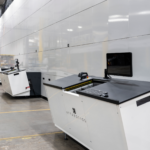
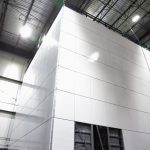
Attabotics stores inventory in bins inside a dense Cubic Storage Structure, with Attabot™ robots traveling horizontally and vertically throughout the entire structure. Every bin is directly accessible in under 90 seconds, with no digging through stacked inventory, and the system runs pick, pack, and ship as one integrated flow of sequencing, sortation, and conveyance.
Published specs that map to the five pressures:
- Up to 85% reduction in warehouse space versus traditional racking
- Direct access to any storage location in under 90 seconds; robots travel at 2.7 m/s
- Frees up to 75% of the labor typically required
- Bins with up to 16 custom compartments keep look-alike SKUs separated
- No single point of failure; robots recharge on supercapacitors while working, and new robots and workstations add without stopping the operation
- Structure builds up to 12 meters (39'5") and works around building columns and walls
Proof in production: Gordon Food Service's Calgary distribution center has run the system since 2018 alongside legacy picking, with a 2X throughput efficiency improvement and the largest gains at peak demand. Best fit: high-SKU, each-pick operations where order variety is high and the building can't grow.
Grid-Based Cube Storage — AutoStore
AutoStore pioneered the stacked-bin grid: bins sit directly on top of one another, robots travel across the top surface and dig down to retrieve them. The company reports up to 4x storage capacity versus a manual warehouse, a 75% footprint reduction, 99.7% uptime, and fulfillment speeds over 500% faster than manual picking. Software keeps fast-moving bins near the top of the stack, which suits stable, predictable demand. The tradeoff is the dig: bins buried under others must be uncovered first, which is where unpredictable e-commerce demand profiles apply pressure.
Robotic Shuttle Systems — Dematic, Swisslog, and Others
Shuttles travel level to level on rails inside a rack structure, delivering totes and cases at published rates of 200 to 1,000 lines per hour per aisle as shuttles are added. Shuttle systems shine at high sustained throughput per aisle and handle heavier totes (35–110 pounds). They keep the aisle-and-lane structure cube storage eliminates, so they're less dense, and deep-lane configurations can require moving totes to reach others.
Vertical Climbing Robots — Exotec Skypod
Exotec's robots climb the outside of racking up to 14 meters, traveling at up to 4 m/s with a 30 kg payload, and a single robot can handle up to 400 totes per hour. Every bin is directly accessible without moving others. The racking-based design is less dense than a sealed cube but installs around existing layouts, and it's a strong fit for mid-to-high SKU e-commerce with heavier totes.
Floor Robots (AMRs) — Shelf-to-Person Systems
Autonomous mobile robots carry portable shelving units to pick stations at 100 to 300 lines per hour depending on fleet size. AMRs need no fixed structure, deploy fast, and scale by adding units, which makes them the lowest-commitment entry into goods-to-person picking. Storage density is the lowest of the group, since inventory still lives on shelving at human scale, and throughput tops out below the structural systems.
Worth Knowing: VLMs and Mini-Load
Vertical lift modules (125–350 items per hour) and crane-based mini-load systems (60–120 lines per hour) are mature, reliable technologies better matched to slower-moving inventory, parts distribution, or buffer storage than to primary e-commerce each-pick fulfillment.
Side by Side
| System type | Example | Each-pick throughput | Density | Access model |
|---|---|---|---|---|
| Full 3D cube storage | Attabotics | Any bin < 90 sec, direct | Up to 85% space reduction | Direct, no reshuffling |
| Grid cube storage | AutoStore | 500%+ vs. manual (vendor claim) | Up to 75% footprint reduction | Top-down dig through stack |
| Robotic shuttle | Dematic, Swisslog | 200–1,000 lines/hr/aisle | Moderate (keeps aisles) | Direct within lane depth |
| Climbing robots | Exotec Skypod | Up to 400 totes/hr/robot | Moderate (racking-based) | Direct |
| Floor AMRs | Shelf-to-person fleets | 100–300 lines/hr | Lowest (human-scale shelving) | Shelf delivered to picker |
Throughput figures are published vendor and industry numbers for typical configurations; actual performance depends on order profile and system design.
Which System Wins for Your Operation
Four questions settle most evaluations:
- How unpredictable is demand across your catalog? Stable, fast-mover-heavy profiles suit grid storage's top-loaded optimization. Long-tail catalogs where any SKU can sell tonight favor direct-access designs like Attabotics' full 3D movement, because there's no penalty for picking a cold item.
- How constrained is the building? If growth means fitting more into the walls you have, density decides, and cube storage leads the field. If you have floor to spare and want speed to deploy, AMRs or climbing robots move faster from contract to go-live.
- What happens at peak? Ask each vendor how capacity scales: adding robots without downtime (cube systems), adding shuttles per aisle, or adding AMR units. Then ask what the labor plan looks like in week 48.
- What does failure look like? E-commerce windows leave no slack for downtime. Favor architectures with no single point of failure, where one robot down means slightly less capacity rather than a stopped operation.
FAQ
What is the best automated storage system for e-commerce order fulfillment?
It depends on the order profile, but high-SKU, each-pick e-commerce operations are best served by cube storage systems, the densest goods-to-person category. Attabotics' full 3D design reaches any bin in under 90 seconds with no reshuffling; AutoStore's grid design optimizes bin stacking by demand. Shuttles, climbing robots, and AMRs each fit specific throughput and building profiles.
How much faster is automated fulfillment than manual picking?
Goods-to-person modeling by material handling integrators shows pick rates rising from roughly 60 to about 450 lines per hour per person, driven by removing the walking that consumes over half of a manual picker's time. AutoStore states its system fulfills orders more than 500% faster than manual picking.
How does automated storage handle Q4 peak volume?
By adding machine capacity rather than seasonal headcount. Attabotics' system adds robots and workstations without interrupting the operation; shuttle systems add shuttles per aisle; AMR fleets add units. The labor need stays close to flat while throughput scales.
What accuracy improvement should e-commerce operations expect?
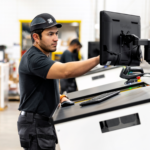
Goods-to-person systems remove the walk-and-search steps where most errors happen: the system selects the bin and presents it to a directed workstation. With industry estimates of $30 to $100+ per mispick, accuracy gains are a first-order line in the business case, not a footnote.
Can automated storage fit in an existing e-commerce warehouse?
Usually. Attabotics' structure works around columns, walls, and corners and builds to the height the facility allows, up to 12 meters. AMR systems need only floor space. Racking-based robot systems install around conventional layouts. The building is a design input, not a disqualifier.
Conclusion
The best automated storage system for e-commerce order fulfillment is the one matched to your order profile and your building, but the field sorts cleanly. Cube storage owns density and each-pick complexity, with Attabotics' full 3D design removing the reshuffling penalty as catalogs grow unpredictable. Shuttles own sustained per-aisle throughput. Climbing robots and AMRs trade density for deployment speed. What none of them do is get cheaper to delay: every quarter on manual picking pays full wages for walking, absorbs mispick costs, and meets peak with a hiring scramble. Pick the system that fits, and pick it while your competitors are still recruiting pickers.
Sources
- Attabotics — Warehouse Automation Technology — all Attabotics specs: space and labor figures, robot speed, 90-second access, bin compartments, height, redundancy, expansion
- Attabotics — Gordon Food Service Calgary Case Study (PDF) — 2X throughput efficiency since 2018
- AutoStore — Benefits — 4x capacity, 75% footprint, 500%+ speed, 99.7% uptime claims
- Kardex — 8 Types of Automated Storage and Retrieval Systems — shuttle, VLM, mini-load, and AMR throughput and capacity figures
- Exotec — Skypod System — robot speed, climb height, payload, totes-per-hour figures (as published in vendor materials and trade coverage)
- Integrated Systems Design — Warehouse Labor Costs — 57% travel time, 60 vs. 450 picks/hour goods-to-person model
- Raymond West — Mispick Elimination — per-mispick cost estimates