An automated storage and retrieval system, or ASRS, is a combination of hardware and software that stores, retrieves, and moves inventory inside a warehouse without a person walking the aisles. For high-density warehouses, where floor space is limited and order volume keeps climbing, the ASRS category has moved well past conveyors and single-direction shuttles into fully three-dimensional systems that use vertical space as efficiently as floor space.
Attabotics builds one of these systems: a cube-shaped storage structure with robots that travel in three dimensions to reach any stored item directly, without digging through bins or shifting product out of the way first. Below is a breakdown of how it works, what it delivers in a high-density environment, and where it fits.
Why High-Density Warehouses Need a Different Kind of ASRS
Traditional warehouse storage runs on aisles: long rows of shelving accessed by forklifts or pickers walking a fixed path. That layout is simple to build, but it wastes vertical space and forces companies to expand their footprint every time order volume grows.
A high-density warehouse needs the opposite approach: maximum storage and throughput inside a fixed footprint. That means:
- Storing more SKUs in the same square footage
- Reaching any item quickly, regardless of where it sits in the structure
- Scaling throughput without scaling floor space
- Reducing dependence on manual labor for repetitive picking and walking
Cube-based ASRS systems, including Attabotics' Cubic Storage Structure, were built around exactly this problem: condense the storage footprint vertically and let robots do the walking in three dimensions instead of one.
How Attabotics' Cube Storage System Works
Attabotics' system is made up of four parts working together: a storage structure, robots, workstations, and software.
The Cubic Storage Structure is a modular, configurable storage grid that fits into an existing warehouse or a new build, without floor remediation. It comes in two bin sizes with up to 16 custom storage compartments and a weight limit of up to 45kg per bin. The structure condenses fulfillment space by up to 85% compared to traditional aisle-based storage. [INTERNAL LINK: /technology "See the full Cubic Storage Structure specs"]
The Attabot™ robot moves both horizontally and vertically inside the structure, at a travel speed of 2.7 meters per second, giving it direct access to every storage location instead of a fixed path. It has no single point of failure: if one robot goes down, the rest of the system keeps running. It also runs without a battery, recharging on supercapacitors while it works, so there's no dedicated charging downtime built into operations.
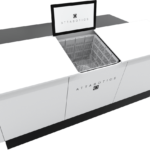
Presentation Stations are the workstations where orders are received and where new inventory is loaded into the structure. Any order can be completed at any station, and stations can be added later without interrupting operations. Each one supports picking, decanting, cycle counts, and kitting, selectable through the on-screen interface.
Attabotics Software is the order management and control layer purpose-built for the Cubic Storage Structure. It handles sequencing, sortation, and conveyance, and connects to existing ERP or WMS platforms through a communications layer, regardless of the host system's API.
Together, these four parts let the system complete direct access to any storage location, and full single-order fulfillment, in 90 seconds or less.
Key Benefits for High-Density Warehouses
The core value of a cube-based ASRS comes down to three numbers Attabotics cites consistently across its product materials:
- Up to 85% reduction in warehouse space, by condensing traditional aisles into a single vertical structure
- Up to 75% reduction in labor, by shifting picking and walking to robots and freeing staff for higher-value tasks
- Up to 50% reduction in CapEx, by fitting into existing facilities without expansion or major construction
Beyond those headline figures, the system is built to keep working under real operating conditions: it runs in both ambient and chilled environments (2°C to 40°C, 15–90% non-condensing humidity), which matters for cold chain and grocery operators, and it's modular enough to add storage or throughput capacity without disrupting operations already in progress.
Where High-Density ASRS Fits
Because the Cubic Storage Structure is modular and doesn't require floor remediation, it can be deployed in several different warehouse contexts:
- Retrofit warehouse — installed inside an existing facility without expanding the footprint
- New warehouse — designed into a new build's layout and cost structure from the start
- Dark store — a fulfillment-only location with no in-person shopping
- Micro-fulfillment center — a smaller, automated facility placed closer to customers
- Store-within-a-store — a compact deployment inside existing retail space
It's also industry-agnostic. Attabotics' published customer base spans retail, e-commerce, e-grocery, apparel, food and beverage, and home goods, and the system can automate roughly 75% of a typical grocery store's SKUs, covering about 60% of total sales volume. [INTERNAL LINK: /applications "See industry-specific use cases"]
Real-World Deployments
Two publicly documented Attabotics installations illustrate how this plays out:
- Gordon Food Service, Calgary has used Attabotics' system since 2018, integrating it directly into the food distributor's existing manual picking operations to increase fulfillment throughput.
- U.S. Department of Defense selected Attabotics, in partnership with KPMG, to install the Cubic Storage Structure as part of a prototype 5G Smart Warehouse Experiment for the Marine Corps Logistics Command in Albany, Georgia, testing autonomous robotic inventory management alongside 5G-enabled technologies.
[EXTERNAL LINK: US Bureau of Labor Statistics, JOLTS report on warehousing labor demand, https://www.bls.gov/news.release/jolts.t01.htm]
FAQ
What is an automated storage and retrieval system (ASRS)?
An ASRS is a system of hardware and software that stores, retrieves, and moves inventory in a warehouse with minimal manual handling. Cube-based ASRS systems, like Attabotics', use robots that travel in three dimensions instead of relying on aisles, conveyors, or fixed-path shuttles.
Does the warehouse building need to be a specific shape?
No. Attabotics' system is designed to work around walls, corners, and existing building columns, so it fits an irregular footprint rather than requiring a clean rectangle.
How tall can the storage structure be built?
Attabotics systems can be built up to roughly 9 meters (about 29.5 feet), depending on the facility.
Can it integrate with our existing WMS or ERP?
Yes. A communications layer connects to any host system regardless of API, once it's specified.
Do the robots need downtime to charge?
No. The Attabot™ robot charges continuously on supercapacitors while working inside the structure, so there's no separate charging downtime built into operations.
What temperature range can the system operate in?
The system runs in both ambient and chilled environments, from 2°C to 40°C, with non-condensing humidity between 15% and 90%.
Is maintenance required at the top of the structure?
No. All maintenance is done at ground level through dedicated robot maintenance bays.
Conclusion
For a high-density warehouse, the limiting factor is almost never demand. It's space, labor, and how fast a system can get product into an operator's hands. Cube-based ASRS technology, with 3D robot travel, in-structure sortation, and software that manages the whole flow, addresses all three at once. Attabotics technology, now developed and supported by LaFayette Systems, is one of the systems built specifically around that problem.