Shuttle ASRS and cube storage get grouped together often, and it's easy to see why: both replace static racking with automated retrieval, and both report significant density gains over a forklift-and-aisle layout. But they solve the density problem with different mechanics, and those mechanics decide which one actually fits a given operation.
Here's how each category works, what the numbers say, and where the difference matters most.
How Shuttle ASRS Works
A shuttle ASRS system uses motorized shuttle carts that travel horizontally along storage lanes inside a rack structure, while a lift or stacker crane moves the shuttle (or the load) between levels and aisles. More advanced multi-deep designs use a mother-child shuttle: a primary shuttle navigates the aisle while a secondary shuttle handles the actual placement deep into a lane.
By eliminating wide forklift aisles and packing storage into deep lanes instead, shuttle systems typically increase storage density by 30–50% over conventional pallet racking. Vendors in this category include Dematic, whose Multishuttle system can exceed 1,000 picks per hour per aisle, and Swisslog, which offers CycloneCarrier for case and tote storage (scalable up to 150 meters long and 25 meters high) alongside PowerStore and AgileStore for pallet-level storage.
The key mechanical detail: a shuttle still operates within a defined lane, level, and aisle. Reaching a specific item means the right shuttle, on the right level, in the right aisle, retrieving from the right lane, a more automated version of the same aisle-and-level logic static racking uses, just executed by machine instead of a forklift operator.
How Cube Storage Works
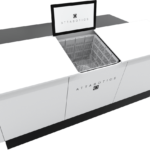
Cube storage, the category Attabotics builds in, removes the lane-and-aisle structure entirely. Instead of racking organized into aisles with lifts at each end, inventory sits inside a single dense cube-shaped structure, and robots move through that structure directly.
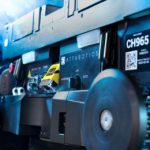
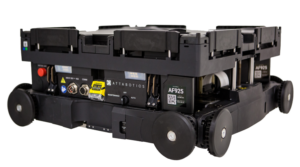
Attabotics' Attabot™ robot moves both horizontally and vertically throughout the Cubic Storage Structure, at 2.7 meters per second, reaching any storage location directly rather than following a fixed lane-and-lift path. That gives the system:
- Direct access to any storage location in under 90 seconds
- Up to 85% reduction in warehouse space versus traditional racking
- No single point of failure: if one robot goes down, the rest of the system keeps running
- Structure height up to roughly 12 meters (39'5"), depending on the facility
Because there's no lane to travel down or lift to wait for, a robot doesn't need to be in a specific aisle to reach a specific item. It goes there directly, from wherever it currently is in the structure.
The Core Difference
Both categories beat static racking by removing forklift aisles. The difference is what replaces them:
- Shuttle ASRS replaces wide forklift aisles with narrower automated lanes, but keeps the underlying logic of aisles, levels, and lane depth. A shuttle is still confined to the level and aisle it's assigned to (or moved between by a lift), and multi-deep lanes mean a shuttle sometimes has to work past nearer items to reach one stored deeper in the same lane.
- Cube storage removes the lane concept altogether. A robot with full three-dimensional freedom reaches any point in the structure directly, with no lane order to manage and no lift dependency for level changes.
That structural difference is reflected in the density figures each category reports against the same baseline: shuttle ASRS is commonly cited at 30–50% space reduction over static racking, while Attabotics' cube storage reports up to 85%. Those numbers come from different methodologies and vendors rather than a single controlled comparison, but the gap tracks with the mechanical difference: a system with no lanes to manage has fewer structural constraints on density than one that still organizes storage around them.
Side-by-Side Comparison
| Shuttle ASRS | Cube Storage (Attabotics) | |
|---|---|---|
| Robot movement | Horizontal within a lane; lift moves it between levels/aisles | Full 3D, throughout the structure |
| Organized around | Aisles, levels, and storage lanes | No aisles or lanes |
| Typical density gain vs. static racking | 30–50% | Up to 85% |
| Deep-lane reshuffling | Yes, for items stored behind others in the same lane | No |
| Best suited for | High-throughput pallet or tote storage with deeper SKU quantities per lane | High-SKU-count, mixed-item, each-pick operations needing direct access to any location |
| Common vendors in category | Dematic (Multishuttle), Swisslog (CycloneCarrier, PowerStore, AgileStore) | Attabotics |
Which Fits Dense Storage Better
"Dense storage" isn't one problem; it depends on what's being stored and how it's picked:
- High-volume, fewer SKUs, pallet or case quantities: Shuttle ASRS is a strong fit. Deep-lane storage works well when multiple units of the same SKU sit together, and systems like Dematic's Multishuttle are built for that throughput profile, especially in food and beverage or bulk distribution.
- High SKU count, mixed-item, each-level picking: Cube storage tends to fit better. Because there's no lane order to manage, a system with full 3D robot movement gives direct access to any single item regardless of what's stored around it, which matters more as SKU variety and order complexity increase.
- Facility with an irregular footprint or existing columns: Cube storage systems designed around this constraint, like Attabotics' structure, work around walls and columns rather than requiring a clean rectangular layout the way an aisle-and-lane system generally needs.
FAQ
What's the main mechanical difference between shuttle ASRS and cube storage?
Shuttle ASRS organizes storage into aisles, levels, and lanes, with shuttles moving within a lane and lifts moving them between levels. Cube storage removes that structure entirely, with robots moving in three dimensions directly to any location in the structure.
Which category has higher storage density?
Shuttle ASRS commonly reports 30–50% space reduction over static racking. Attabotics' cube storage reports up to 85%. These figures come from different vendors and methodologies rather than one controlled study, but the gap generally tracks with the mechanical difference: fewer structural constraints on movement tend to mean higher density.
Does a shuttle system ever need to move items out of the way to reach one behind them?
Yes, in multi-deep lane configurations, a shuttle can need to work past nearer items in the same lane to reach one stored deeper in it. Cube storage systems with full 3D robot movement don't have this constraint, since there's no lane to work through.
Is shuttle ASRS or cube storage better for high SKU counts?
Cube storage tends to fit high-SKU-count, mixed-item operations better, since a robot with full 3D movement can reach any individual location directly. Shuttle ASRS tends to fit better where fewer SKUs are stored in higher volume per lane, which is common in pallet or bulk case distribution.
Can either system go into an existing warehouse?
Both categories can be installed in existing facilities, though specifics vary by vendor. Attabotics' Cubic Storage Structure is designed to install without floor remediation and to work around existing walls and columns. Confirm site-specific constraints directly with each vendor.
Conclusion
Shuttle ASRS and cube storage both improve meaningfully on static racking, and both are legitimate answers to a space problem. The difference comes down to whether storage still gets organized around aisles, levels, and lanes, the way shuttle systems from vendors like Dematic and Swisslog do, or whether that structure gets removed entirely, which is what full three-dimensional robot movement in cube storage systems like Attabotics' is built to do. For an operation with high SKU variety and each-level picking, that structural difference is usually what decides the fit.
Sources
- Attabotics — Warehouse Automation Technology — Attabotics robot specs, structure specs, space reduction figure, FAQ
- NOVA Racking — What Is Multi Deep Shuttle ASRS and How Does It Work — shuttle ASRS mechanics, mother-child shuttle design
- Addverb — Multi Deep Shuttle ASRS: Benefits, Applications, and Innovations — 30-50% density gain figure over conventional racking
- Dematic — Multishuttle — Multishuttle throughput and design specs
- Swisslog — CycloneCarrier Case Shuttle & Mini Load ASRS Solution — CycloneCarrier specs (length, height, deep storage)
- Swisslog — Warehouse Shuttle Systems & Solutions — PowerStore and AgileStore pallet shuttle overview
- Automated Warehouse — Swisslog to Debut AgileStore Pallet Shuttle Storage System — AgileStore 4-way pallet shuttle details