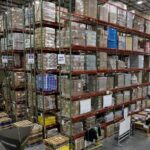
An automated cube storage system stores inventory in bins packed into a dense, cube-shaped structure, with robots retrieving those bins and delivering them to workstations. No aisles, no shelving, no pickers walking to product. It is the densest form of automated storage and retrieval system (ASRS) available, and for operations facing high-density fulfillment demands in buildings that can't grow, it changes what a warehouse's square footage is worth.
This page covers what cube storage is, each benefit with the published numbers behind it, the difference between the two cube storage designs on the market, and how to judge whether it fits your operation.
What Is an Automated Cube Storage System?
A cube storage system has four core components: a storage structure filled with bins, robots that retrieve them, workstations where operators pick and pack from delivered bins, and control software orchestrating all of it. Inventory sits in the cube at maximum density because the design eliminates what makes conventional warehouses sparse: aisles for people and forklifts, and the vertical gaps between shelf levels.
The category has two distinct designs:
- Grid-based cube storage. Bins stack directly on top of one another inside an aluminum grid, and robots travel across the top surface, digging down to retrieve bins and delivering them to ports. AutoStore pioneered this design and reports it reduces storage footprint by 75% compared to other storage solutions.
- Full 3D cube storage. Attabotics builds the structure so the Attabot™ robot moves horizontally and vertically throughout the entire Cubic Storage Structure rather than working from the top surface. Every storage location is directly accessible in under 90 seconds, with no digging through stacked bins, and the design reduces warehouse space by up to 85%.
Both designs serve the same buyer problem. The mechanical difference between them shows up in access speed, reshuffling, and how the system behaves as SKU counts climb, which is covered below.
Benefit 1: Up to 85% Less Warehouse Space
The headline benefit is density. A conventional racking layout spends most of its floor on aisles and most of its air on nothing: racking stops where a forklift's reach stops, while the building's clear height keeps going. Cube storage recovers both. Bins pack edge to edge and floor to top of structure, with Attabotics' system building up to 12 meters (39'5") and reducing fulfillment space by up to 85% versus traditional racking. AutoStore reports up to 4x storage capacity in the same footprint compared to a manual warehouse.
What that buys, concretely:
- Growth without a new building. An operation out of room can multiply its storage positions inside the walls it already has, avoiding expansion capital and a second lease.
- Fulfillment closer to customers. Density makes small-footprint urban fulfillment economical, because a viable operation fits in a fraction of the space.
- Freed floor becomes revenue floor. Space recovered from storage can absorb value-added services, returns processing, or more throughput capacity.
Attabotics' structure also works around building columns, walls, and corners rather than requiring a clean rectangle, which matters in the real buildings most operations already occupy.
Benefit 2: Throughput Built for High-Density Fulfillment
Density without speed would just be a warehouse-shaped closet. Cube storage pairs it with goods-to-person throughput: robots deliver bins to stationary operators, removing the travel time that consumes over half of a manual picker's day.
In Attabotics' system, the robot fleet reaches any storage location in under 90 seconds, travels at 2.7 m/s in three dimensions, and the software runs fulfillment in 90-second waves of sequencing, sortation, and conveyance inside the cube. Orders complete at any workstation, in one integrated pick, pack, and ship flow. AutoStore states automation of this class speeds order fulfillment by more than 500% versus manual picking.
The proof point that matters is sustained performance: Gordon Food Service's Calgary distribution center has run Attabotics' system alongside its legacy picking operations since 2018 and reports a 2X throughput efficiency improvement within the system, with the gains most valuable at peak demand.
Benefit 3: Most of the Picking Labor Comes Back
Time studies of manual picking show roughly 57% of a picker's time goes to walking and only about 10% to actually picking. Cube storage deletes the walking category outright, which is why Attabotics reports freeing up to 75% of the labor typically required, with those people redirected to work better suited to them. Fewer, better-paid roles are also easier to fill and keep, a compounding advantage while warehouse wage floors keep rising.
Benefit 4: Fewer Places for Errors to Happen
In high-density fulfillment, error rates scale with volume, and industry estimates price a single mispick between $30 and $100 or more once returns, re-ships, and goodwill are counted. Cube storage restructures the accuracy problem: the system selects the bin and presents it, so nobody chooses among look-alike SKUs on open shelving. Attabotics' bins hold up to 16 custom compartments to keep SKUs physically separated, and workstations switch into cycle count mode so inventory verification happens as part of normal work.
Benefit 5: Scaling Without Stopping
High-density operations grow, and the system has to grow under load. In Attabotics' design, new robots and workstations install without interrupting the operation, and the modular structure expands as volume climbs. Reliability is handled architecturally: there is no single point of failure, so the system keeps fulfilling orders if a robot goes down, robots recharge on supercapacitors while working with no charging downtime, and all maintenance happens at ground-level bays. AutoStore reports 99.7% uptime for its grid design; Attabotics attributes its own uptime claim, the highest of any cube-based ASRS, to the 3D structure and purpose-built software.
Grid-Based vs. Full 3D: The Difference That Matters at High Density
The two cube designs diverge exactly where high-density fulfillment applies pressure:
| Factor | Grid-based cube storage | Full 3D cube storage (Attabotics) |
|---|---|---|
| Robot movement | Across the top of the grid | Horizontal and vertical throughout the structure |
| Bin access | Dig down through stacked bins; software keeps fast movers near the top | Direct access to any location, under 90 seconds |
| Reshuffling | Required for buried bins | None by design |
| Space reduction (published) | Up to 75% | Up to 85% |
| Structure height | Varies by vendor | Up to 12 m (39'5") |
| Building fit | Grid footprint | Works around columns, walls, corners |
The reshuffling line is the one to watch as SKU counts and order variety grow. A grid design's software mitigates bin-digging by predicting demand, and it does that well for stable, fast-moving profiles. But high-SKU, each-pick operations pull unpredictably from the whole catalog, which is where direct access to every location without moving other inventory stops being a detail and becomes the throughput model.
Who Automated Cube Storage Fits
Cube storage earns its return where these pressures stack:
- High SKU counts with each-pick complexity, such as e-commerce, omnichannel retail, and consumer goods distribution
- Buildings that can't expand, whether by lease, land, or capital constraints
- Urban or market-proximate fulfillment, where every square foot carries premium cost
- Seasonal peaks, where throughput must scale without a hiring surge
- Grocery and CPG distribution, where Attabotics' system covers roughly 75% of grocery SKUs and operates from 2–40°C for mixed-temperature zones
Operations dominated by pallet-in, pallet-out flows or very low SKU counts are better served by other ASRS categories, and an honest evaluation starts by matching the technology class to the inventory profile.
FAQ
What is an automated cube storage system?
A type of ASRS that stores inventory in bins packed into a dense cube-shaped structure, with robots retrieving bins and delivering them to operator workstations. It eliminates aisles and shelving gaps, making it the densest automated storage category available.
How much warehouse space does cube storage save?
Published figures: Attabotics reports up to 85% space reduction versus traditional racking with its full 3D design, and AutoStore reports 75% footprint reduction and up to 4x capacity with its grid design. Actual results depend on the building, inventory profile, and configuration.
What's the difference between AutoStore-style grid storage and Attabotics' 3D system?
In grid designs, robots work from the top of the stacked-bin grid and dig to reach buried bins. In Attabotics' design, robots travel horizontally and vertically throughout the structure with direct access to any bin in under 90 seconds and no reshuffling.
Is cube storage right for high-density fulfillment operations?
It's built for them. The category fits high-SKU, each-pick operations in constrained buildings, including e-commerce, retail, grocery, and CPG distribution. Pallet-heavy or very low-SKU operations usually fit other ASRS types better.
Can a cube storage system be expanded after installation?
Yes. Attabotics' system adds robots and workstations without interrupting the operation, and the modular structure expands with volume. Scalability under load is one of the category's core benefits for growing operations.
Conclusion
The benefits of automated cube storage compound from one design decision: pack inventory at full density and make robots, not people, do the traveling. Space drops by as much as 85%, throughput rises on goods-to-person speed, most picking labor comes back, errors lose their habitat, and the system scales without downtime. For high-density warehouse fulfillment, the practical question isn't whether cube storage outperforms racking; the published numbers have settled that. It's which cube design matches your inventory profile, and whether your building's unused cubic height is an asset you keep ignoring or the cheapest expansion you'll ever make.
Sources
- Attabotics — Warehouse Automation Technology — 85% space reduction, robot specs, 90-second access and waves, bin compartments, 12 m height, workstation modes, supercapacitors, no single point of failure, expansion without interruption
- Attabotics — Gordon Food Service Calgary Case Study (PDF) — 2X throughput efficiency alongside legacy operations since 2018
- AutoStore — Space Benefits — 4x storage capacity, 75% footprint reduction claims
- AutoStore — Benefits Overview — 500%+ fulfillment speed and 99.7% uptime claims
- Integrated Systems Design — Warehouse Labor Costs — 57% travel / 10% picking time breakdown
- Raymond West — Mispick Elimination — per-mispick cost figures