Warehouse rent doesn't go down. When a facility runs out of room, the usual answer is to lease more of it, and that cost compounds every year the business grows. Cube-based automation exists to break that pattern: instead of adding square footage, it adds storage density to the footprint already paid for.
Not every cube-based system delivers the same amount of density, though, and the mechanical differences between them are what decide how much space a given warehouse actually gets back. Below are five cube-based systems ranked by publicly documented footprint reduction, with the specifics behind each figure.
What Makes a Storage System "Cube-Based"
A cube-based system stores inventory in a dense three-dimensional structure rather than in rows of shelving spread across a floor. Robots retrieve items from inside or on top of that structure instead of a person walking to a fixed location. The category includes several different mechanical approaches: robots that travel across the top of a stacked bin grid, robots that move fully in three dimensions through a structure, and robots that climb standard racking. All of them aim at the same outcome: more storage per square foot than aisle-based shelving allows.
Ranked by Footprint Reduction
1. Attabotics — Up to 85% Space Reduction
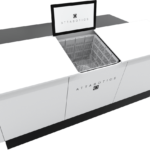
Attabotics' Cubic Storage Structure is a modular cube with fully three-dimensional robot travel. The Attabot™ robot moves both horizontally and vertically throughout the structure at 2.7 meters per second, reaching any storage location directly rather than working from a fixed top plane.
- Up to 85% reduction in warehouse space, per Attabotics' own published figures
- Direct access to any storage location in under 90 seconds
- Fits into an existing facility without floor remediation, including irregular footprints with walls, corners, and columns
- Structure height up to roughly 12 meters (39'5"), depending on the facility
- Also reduces labor by up to 75%, since robots handle the walking and retrieval
Because the robot isn't limited to operating from the top of the structure, there's no need to move bins out of the way to reach one buried lower down, which is part of how the system reaches its density figure.
2. AutoStore — Up to 75% Space Reduction (Higher in Some Deployments)
AutoStore popularized the stacked-bin cube grid: bins sit stacked directly on top of each other inside an aluminum grid, and robots travel across the top surface, lowering a lift to retrieve a specific bin. AutoStore's own materials cite up to 75% space reduction as the standard figure, and individual deployments have gone further. Footwear retailer eXXpozed reported an 87% reduction, needing 450 m² versus the 3,500 m² an equivalent traditional warehouse would require.
- 75% typical footprint reduction, per AutoStore
- Case-by-case results ranging as high as 87% in some deployments, and as low as roughly 40% in others depending on facility constraints
- Global average system availability of 99.6%, per AutoStore's published uptime figures
- Because robots work from the top of the stack, reaching a bin buried deeper means temporarily moving the bins above it, a process AutoStore's software optimizes by keeping frequently picked inventory near the top
3. Exotec Skypod — Up to Roughly 67% Space Reduction
Exotec's Skypod system uses standard-style racking instead of a stacked bin grid, with robots that climb the outside of the racking directly to the level holding the needed item. Exotec has stated that an average 18,000 m² warehouse footprint can shrink to roughly 6,000 m², a reduction of about 67%, without a loss in capacity. Real deployments land in a similar range: Decathlon's rollout of roughly 300 Skypod robots across European sites cut storage footprints in half, and grocery retailer Auchan Luxembourg's implementation occupies 749 m², down from 2,200 m² previously, about a 66% reduction.
- Roughly 50–67% footprint reduction across cited examples
- Robots climb racking at up to 4 m/s, up to 14 meters high
- Because Skypod uses standard-style racking rather than a stacked bin grid, no bin sits directly on top of another, so there's no reshuffling step to reach a specific item
4. Ocado Storage and Retrieval System — Density Gains Over Comparable Grid Systems
Ocado's system uses a similar top-of-grid robot design to AutoStore's, most commonly deployed for grocery e-commerce fulfillment. Ocado doesn't publish a single headline footprint-reduction percentage the way Attabotics or AutoStore do; instead, it positions its density advantage relative to other cubic ASRS systems. Ocado states its Grid offers 33–51% more vertical storage capacity per floor than comparable cubic ASRS solutions, stacking bins up to 21 high (7.6 meters) within a 12-meter facility. Its metal bin design also removes the need for fire breaks required by some competing systems, reclaiming up to 20% of cubic storage space that would otherwise go unused.
- 33–51% more vertical storage capacity per floor versus comparable cubic ASRS systems, per Ocado
- Up to 20% additional usable cubic space reclaimed by eliminating fire-break requirements
- Grid stacks up to 21 bins high (7.6 meters) inside a 12-meter warehouse
5. Hai Robotics ACR — Up to 75% Space Reduction, No Dedicated Grid Required
Hai Robotics' Autonomous Case-handling Robots (ACR) skip a purpose-built grid or racking system entirely, working with standard warehouse racking already in place and moving vertically to retrieve totes or cartons directly. That lowers the amount of new infrastructure a facility has to install, though it also means density depends more on how the existing racking is laid out rather than a system engineered from the ground up for maximum density.
- Reported footprint reduction of up to 75%
- Reach ranges from roughly 5.2 meters (HaiPick A42) up to 12 meters on telescopic-lift models, depending on the model
- Some models carry payloads up to 300 kg
- Works with racking a warehouse may already own, which shortens installation time compared to a purpose-built grid
Comparing the Five at a Glance
| System | Footprint Reduction | Robot Movement | Works With Existing Racking? |
|---|---|---|---|
| Attabotics | Up to 85% | Full 3D, throughout the structure | No, purpose-built structure |
| AutoStore | Up to 75% (as high as 87% in some deployments) | 2D, on top of a stacked bin grid | No, purpose-built grid |
| Exotec Skypod | ~50–67% | 3D, climbs exterior of racking | Purpose-built racking |
| Ocado OSRS | 33–51% denser than comparable grid systems | 2D, on top of a stacked bin grid | No, purpose-built grid |
| Hai Robotics ACR | Up to 75% | Vertical, on standard racking | Yes |
Why Full 3D Movement Tends to Win on Density
The systems with the highest reported footprint reduction share a common trait: the robot isn't limited to working from a single plane. A robot confined to the top of a grid, like AutoStore's or Ocado's, has to manage bin order and occasionally dig through a stack to reach something buried. A robot that climbs racking from the outside, like Exotec's, avoids digging but still depends on the racking layout underneath it. A robot with full three-dimensional freedom inside a purpose-built structure, which is Attabotics' approach, reaches any point directly and doesn't need bin-order management at all. That structural difference is a large part of why Attabotics reports the highest published reduction figure among cube-based systems reviewed here.
Choosing Among Them
The right system depends on more than the headline percentage:
- Existing racking to reuse: Hai Robotics fits standard racking already in place. Attabotics, AutoStore, Exotec, and Ocado are purpose-built and typically replace, rather than reuse, existing shelving.
- Facility height and shape: Attabotics adapts to irregular footprints with walls and columns; height caps vary by vendor (roughly 12–14 meters across the systems above).
- SKU velocity and grocery/cold chain needs: Ocado and AutoStore are common choices for grocery e-commerce; Attabotics also runs in ambient and chilled environments from 2°C to 40°C.
- Speed of install: A system that works with existing racking generally installs faster than a purpose-built grid or structure, at some cost to maximum density.
FAQ
What is cube-based warehouse automation?
It's a category of automated storage and retrieval system (ASRS) that stores inventory in a dense three-dimensional structure instead of rows of shelving. Robots retrieve items from inside or on top of the structure, replacing manual walking and picking.
Which cube-based system reduces warehouse footprint the most?
Among publicly documented figures, Attabotics reports the highest standard reduction at up to 85%, followed by AutoStore and Hai Robotics at up to 75% each, Exotec at roughly 50–67% depending on the deployment, and Ocado, which reports density gains relative to comparable grid systems rather than a single footprint percentage.
Do all these systems require new infrastructure?
Most do. Attabotics, AutoStore, Exotec, and Ocado each use a purpose-built structure, grid, or racking system. Hai Robotics is the exception, designed to work with standard racking a warehouse may already have.
Why do some systems need to move bins to reach an item, and others don't?
It depends on where the robot operates. Systems where robots travel across the top of a stacked bin grid, like AutoStore and Ocado, sometimes need to move bins above the target out of the way first. Systems with full three-dimensional robot movement, like Attabotics, or exterior racking climbers, like Exotec, reach a specific location directly without digging.
Can cube-based automation go into an existing warehouse, or only new builds?
Several of these systems are designed for retrofits. Attabotics' Cubic Storage Structure installs without floor remediation or expanding the building. Hai Robotics' ACR system is built to work with racking already in place. Confirm site-specific constraints directly with each vendor.
Conclusion
Footprint reduction in cube-based automation comes down to one mechanical question: how directly can the robot reach a specific item without moving other inventory or depending on a fixed travel plane. Systems built around full three-dimensional robot movement, led by Attabotics at up to 85% space reduction, tend to report the highest density figures for exactly that reason. AutoStore, Exotec, Ocado, and Hai Robotics each solve the same space problem with different tradeoffs in installation speed, infrastructure reuse, and maximum density.
Sources
- Attabotics — Warehouse Automation Technology — Attabotics space reduction, robot specs, structure specs, FAQ
- Attabotics — Warehouse Automation Solutions (Applications) — deployment types, temperature range, grocery SKU coverage
- AutoStore — The AutoStore System — 75% space reduction figure, 99.6%/99.8% uptime claims
- AutoStore — eXXpozed Case Study — 87% footprint reduction case example
- AutoStore — DKK-TOA Corporation Case Study — lower-end (40%) reduction case example
- Exotec — Next Generation Skypod Launch — Skypod mechanics and density improvements
- Supply Chain Digital — Exotec & Auchan Luxembourg's Skypod Warehouse Revolution — Auchan footprint figures (749 m² vs. 2,200 m²)
- The Next Web — Decathlon Doubles Warehouse Output With Exotec Robots — Decathlon footprint and productivity figures
- DC Velocity — Exotec Launches Next Generation of Skypod System — Skypod robot speed and height specs
- Ocado Intelligent Automation — Grid — vertical density figures, bin stacking height
- Ocado Intelligent Automation — Why Cubic ASRS Is the Key to Future-Proofing Your Warehouse — density comparison to other cubic ASRS systems, fire-break space reclamation
- Hai Robotics — Products and HaiPick A42T — ACR specs, reach, and payload by model


